
Jaw-in-a-day (JIAD) for malignant indications: A systematic review
Authors: Trac J, Ramchandani R, Dutta P, Sarkis L, Calvisi R, Villemure-Poliquin N, Davies J, Somogyi-Ganss E, Blanas N, Cuddy K, Enepekides D, Higgins K, Philteos J, Eskander A
Affiliation: University of Toronto-led collaboration including Sunnybrook Health Sciences Centre, Sinai Health, Michael Garron Hospital, University of Ottawa, Queen's University, and University of Sydney
Journal: Oral Oncology
PMID: 41422685
Key takeaways
This is a review of true JIAD with same-day interim prosthetic rehabilitation, not a review of all immediate dental implant placement.
The review excluded staged dental rehabilitation protocols in which dental implants were placed during the initial fibula reconstruction but the dental prosthesis was attached later. In other words, immediate implant placement alone did not qualify as JIAD; the prosthesis also had to be placed the same day.
Planned same-day implant-supported prosthetic rehabilitation was achieved in 52/57 patients (91.2%), but prosthesis survival was 25/32 (78.1%) where reported.
All 99 irradiated implants showed early osseointegration, yet 11/99 (11.1%) later failed; osteoradionecrosis was the major late concern.
Background
Jaw-in-a-day (JIAD) combines oncologic resection, fibular free flap reconstruction, dental implant placement, and immediate interim dental rehabilitation in one operation. This definition is important because several oncologic centers use immediate implant placement but intentionally delay vestibuloplasty and prosthetic loading.

Objective
Review published outcomes of JIAD for malignant maxillary or mandibular head and neck tumors.
Methods
Design: PRISMA systematic review using a predefined PROSPERO protocol (CRD420251043510).
Search: MEDLINE, Embase, CENTRAL, Web of Science, and CINAHL from January 2013 through October 1, 2025.
Eligibility: Patients of any age with maxillary or mandibular head and neck cancer treated with JIAD. Cohort studies, case series, and case reports were eligible.
Critical intervention definition: JIAD required an interim prosthesis applied to the dental implants at completion of the ablative and reconstructive operation. Staged reconstruction, including the Rohner method, was excluded.
Evidence base: 9 studies, 57 patients; 7/9 were retrospective and 3 were case reports. Pooled age and sex were not reported.
Reconstruction: All 57 patients received fibular free flaps; all studies used virtual surgical planning. The mandible was the most common site (31/57), and squamous cell carcinoma was the most common pathology (37/57).
Outcomes: Prosthesis placement, final prosthesis, survival, removal, implant failure, peri-implant complications, postoperative complications, and timing of adjuvant radiotherapy.
Analysis: Descriptive statistics only. MINORS scores were 9-12/16 for non-case-report studies and 5 for case reports.
Results
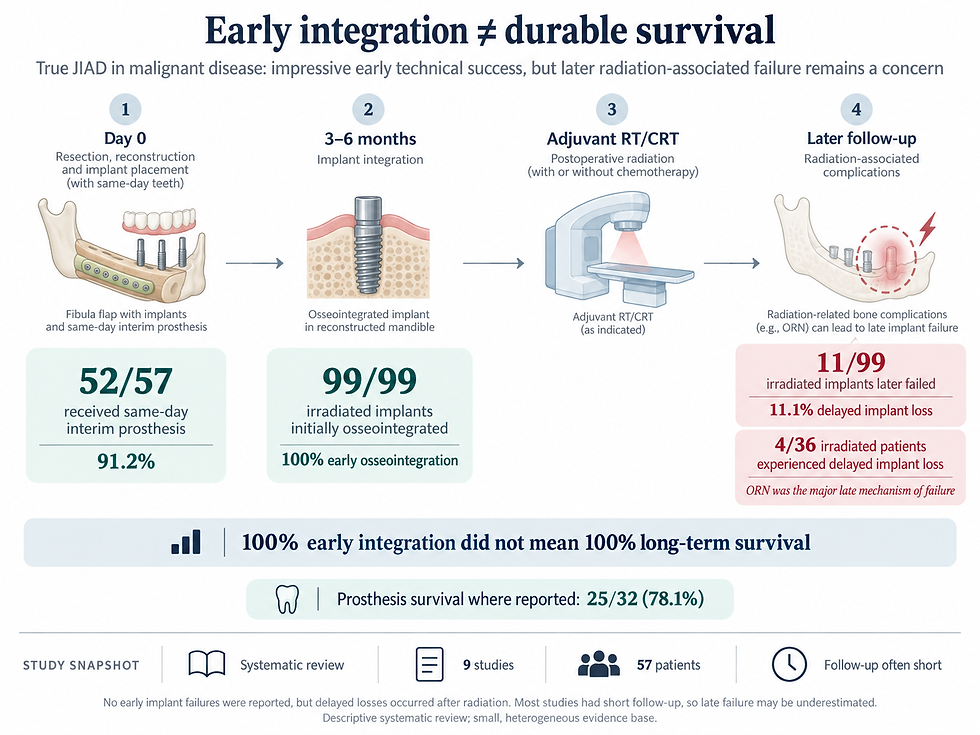
Interim prosthesis: 52/57 patients (91.2%) received the planned prosthesis on the day of surgery.
Prosthesis survival: Reported in 6 studies, with 25/32 prostheses surviving (78.1%) over follow-up ranging from 5 to 52 months.
Irradiated implants: All 99 implants in a radiotherapy field demonstrated early osseointegration. Delayed loss occurred in 11/99 implants (11.1%) across 4/36 irradiated patients.
Osteoradionecrosis: Six prostheses were removed because of ORN. Among patients receiving adjuvant therapy, the authors calculated ORN in 6/36 (16.7%).
Other complications: Three cases of peri-implant mucositis resolved with local treatment. Where reported, cohort-level ORN rates were 15.4-25% and infection rates were 20-30.8%.
Radiation timing: Two studies reported median time to radiotherapy or chemoradiotherapy of 44 and 57 days. Radiation dosimetry and whether ORN involved native versus transplanted bone were not reported.
Conclusion
The authors conclude that JIAD can provide high early implant and prosthetic success in carefully selected oncologic patients, but adjuvant radiation may increase ORN-associated late implant and prosthesis failure. Cancer stage and anticipated need for postoperative radiotherapy should inform patient selection.
Strengths
Predefined protocol, PRISMA reporting, broad multi-database search, independent screening and extraction, and formal risk-of-bias assessment.
Separates early osseointegration from delayed implant loss and reports clinically meaningful prosthesis outcomes.
Limitations
Only 57 patients across 9 small studies, including 3 case reports, with substantial selection and publication bias.
Follow-up was usually under 24 months, likely underestimating late radiation-related failure.
The review excluded staged dental rehabilitation protocols in which implants were placed during the initial fibula reconstruction but the dental prosthesis was attached later. Therefore, its ORN and prosthesis-failure findings should not be generalized to all immediate dental implant protocols.
Outcomes were inconsistently stratified by radiation exposure, preventing valid JIAD versus non-JIAD or irradiated versus nonirradiated comparisons.
Clinical relevance
JIAD appears technically feasible and can deliver immediate dental rehabilitation, but this review addresses the narrow strategy of same-day prosthetic loading. It does not establish that immediate implant placement itself is unsafe in cancer patients, because staged immediate-implant protocols were excluded. For reconstructive surgeons, the key clinical question may be timing of prosthetic loading rather than timing of implant placement alone.
Editorial notes
The central interpretive issue is what counted as JIAD. Patients only qualified if the dental prosthesis was attached during the same operation as tumor resection, fibula reconstruction, and implant placement. The review excluded staged protocols in which the implants were placed during the initial reconstruction but the teeth were attached later.
Memorial Sloan Kettering's immediate dental implant placement (IDIP) workflow places implants at the index fibula reconstruction, then performs vestibuloplasty and implant exposure about 4-6 weeks later, with prosthetic loading shortly thereafter. In Allen et al. (PRS 2020; PMID 33234971), 27 IDIP patients received 72 implants; mean time to prosthetic loading was 55.6 days, 78% completed dental restoration within 1 year, and adjuvant radiotherapy was not delayed. A companion MSK pilot study found no adverse effect of immediate implants on postoperative complications or radiation dosimetry (Sandoval et al., 2020; PMID 31777154).
More recent MSK long-term data further separate immediate implant placement from same-day JIAD: among 148 oncologic mandible reconstructions, 86 IDIP patients received 219 implants and were more likely to achieve dental rehabilitation than non-IDIP patients (69.8% vs 25.8%), with earlier rehabilitation (median 120 vs 355 days); adjuvant radiation was not associated with failure to complete rehabilitation (Allen et al., J Reconstr Microsurg 2026; PMID 40681154). A broader systematic review/meta-analysis of vascularized bone flaps reported 97.0% survival for immediately placed implants versus 89.9% for delayed implants, while confirming that radiation itself adversely affects implant survival (Panchal et al., PRS 2020; PMID 32459736).
These studies do not prove that staged IDIP is superior to true JIAD, because the populations, loading strategies, and outcome definitions differ. They do show that the present review cannot answer the broader question of whether implants should be placed at the time of oncologic fibula reconstruction. A clinically useful next study would directly compare same-day JIAD with immediate implant placement plus delayed loading, using standardized radiation dosimetry, ORN definitions, implant/prosthesis survival, functional outcomes, and long-term follow-up.


Comments