
Patient Preferences for Postmastectomy Breast Reconstruction
Authors: Shammas RL, Hung A, Mullikin A, Sergesketter AR, Lee CN, Reed SD, Fish LJ, Greenup RA, Hollenbeck ST
Affiliation: Duke University; Durham VA Health Care System; The Ohio State University; Yale University; University of Virginia
Journal: JAMA Surgery, December 2023
PMID: 37755818
Background
20-40% of patients experience dissatisfaction or decisional regret after breast reconstruction
Adaptive choice-based conjoint (ACBC) analysis is a survey-based method used in marketing research to determine how consumers value different attributes of a product
In healthcare, ACBC can theoretically help identify individual-level preferences to promote shared decision-making between patients & clinicians
Objective
Identify which attributes of breast reconstruction matter most to women considering surgery and determine how priorities differ between respondents who prefer flap versus implant-based reconstruction
Methods
Design: Web-based, cross-sectional study from 2022-2023
Sample: Of 730 women recruited for the study, only 406 completed the survey (Duke: 105, Love Research Army Registry: 301). Mean age = 55.8 years; 89% were White and 73% married.
Eligibility: Women with a new diagnosis of or genetic predisposition to breast cancer who presented to Duke for consultation for postmastectomy reconstruction OR women identified through the Love Research Army Registry.
Exclusion criteria: Age younger than 18 years, metastatic disease, or did not consider undergoing postmastectomy breast reconstruction
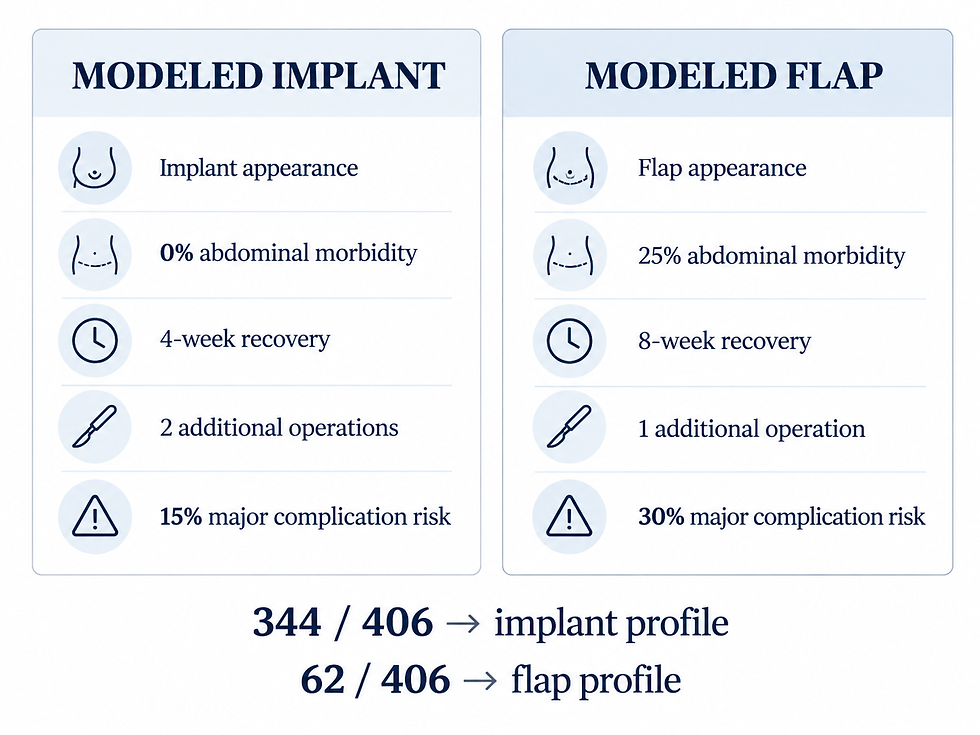
Attributes: Breast appearance, abdominal morbidity (0%, 25%, 50%), recovery (2, 4, 8 weeks), additional operations (1, 2, 3), and major complications (5%, 15%, 30%).
Hypothetical Flap scenario: abdominal morbidity risk 25%, recovery time 8 weeks, 1 additional operation, complication risk 30%
Hypothetical Implant scenario: abdominal morbidity risk 0%, recovery time 4 weeks, 2 additional operations, complication risk 15%
Outcomes: Relative importance, part-worth utilities, and maximum acceptable risks.
Results
Most important attribute in decision-making process was risk of abdominal morbidity (RI 28%), followed by risk of major complications (25%), additional operations (23%), breast appearance (13%), & recovery time (11%)
Most respondents (85%) preferred implant profile --> these respondents most valued abdominal morbidity, risk of complications, & number of additional operations
Respondents who preferred the flap profile (15%) most valued number of additional operations, breast appearance, & complication risk
Participants who were married or college educated were more likely to prefer the flap profile, while income over $75,000 was associated with decreased likelihood of choosing flap profile
Among 344 respondents who preferred the implant profile, 34% actually preferred the flap appearance

Conclusion
This study may lay the foundation for decision support tools that can help promote shared decision making in breast reconstruction.

Key takeaways
Abdominal morbidity, fear of complications, and the need for additional operations were the most important considerations in selecting implant vs flap reconstruction
Most respondents (85%) preferred the study's implant scenario, largely because of lower modeled abdominal morbidity and complication risk
Respondents who preferred the flap scenario tended to favor fewer additional operations & flap appearance
Strengths and Limitations
Strengths
ACBC analysis seeks to examine how women value different aspects of reconstructive care
Attributes selected in the study were identified by literature review, surgeon input, semi-structured interviews, and cognitive pretesting.
Two recruitment sources
Limitations
Self-reported, cross-sectional study with substantial noncompletion
Predominantly White, upper-middle-class cohort limits generalizability
Only simplified implant and abdominal-flap scenarios were modeled. Study failed to capture the nuances inherent in real clinical breast reconstruction
Preferences were hypothetical. Actual choice of reconstruction, patient satisfaction, decisional regret, and clinical outcomes were not tested.
Clinical relevance
This study has limited clinical relevance given its findings were derived from hypothetical scenarios. Real-world decision-making regarding choice of breast reconstruction is highly nuanced. Not all women are in fact candidates for both implant and flap reconstruction due to comorbidities, body habitus, history of radiation, or prior reconstructive history. While the attributes used in the ACBC were rigorously identified and tested, the authors did not explain where they came up with the hypothetical risks of complications, additional operations, or abdominal morbidity used in their survey.
Editorial notes
It is not surprising that many women preferred a 0% chance of abdominal morbidity with implants compared to a non-zero chance of abdominal morbidity with flap reconstruction. This study likely significantly over-estimates the “implant preference” and underestimates the risk of reoperation and dissatisfaction with implants. The finding that married & college-educated women were more likely to prefer flap reconstruction but women with higher incomes were less likely to prefer flap reconstruction was contradictory.


Comments