
Understanding capsular contracture: mechanisms, management, and outcomes in implant-based breast augmentation and reconstruction
Authors: Clark A, Shauly O, Sherrer J, Losken AAffiliation: Emory University, Atlanta, GAJournal: Plastic and Reconstructive Surgery – Global Open, January 2026PMID: 41541241
Key takeaways
Capsular contracture (CC) reflects a chronic peri-implant inflammatory response; bacterial biofilm and radiation are consistent contributors.
Reported CC rates are higher after reconstruction than augmentation (≈19–25% vs 5–19%).
Prevention measures (skin/pocket antisepsis, no‑touch technique, nipple shields, implant/mesh selection) are associated with lower CC in observational studies.
Management is stage‑based: early/mild CC may respond to medical therapy or capsulotomy; severe or recurrent CC generally needs partial/total capsulectomy with implant exchange.
The evidence base is heterogeneous and largely nonrandomized; no RCTs define a single best protocol.
Background
Capsular contracture is among the most common reasons for reoperation after implant-based augmentation and reconstruction. It causes firmness, distortion, and pain. The review synthesizes recent literature (2020–2024) to guide prevention and treatment strategies.
Objective
To provide an updated narrative review of CC mechanisms, epidemiology, diagnosis, prevention, treatment options, and patient outcomes for augmentation and reconstruction patients.
Methods
Design / level of evidence: Updated narrative review of PubMed and Embase (search performed September 21, 2024). Evidence predominantly retrospective and observational (OCEBM levels 2b–5); no randomized trials identified.
Screening: 93 records (2020–2024) identified; 52 studies included after applying inclusion criteria focused on objective outcomes and explicit protocols/dosing/technique descriptions.
Bias assessment: Qualitative assessment across design, confounding/selection, and outcome ascertainment domains; most included studies had moderate-to-high risk of bias.
Results
Pathogenesis and risk factors
CC arises from an amplified foreign-body response with fibrosis and myofibroblast activity. Biofilm is implicated but not singularly causal.
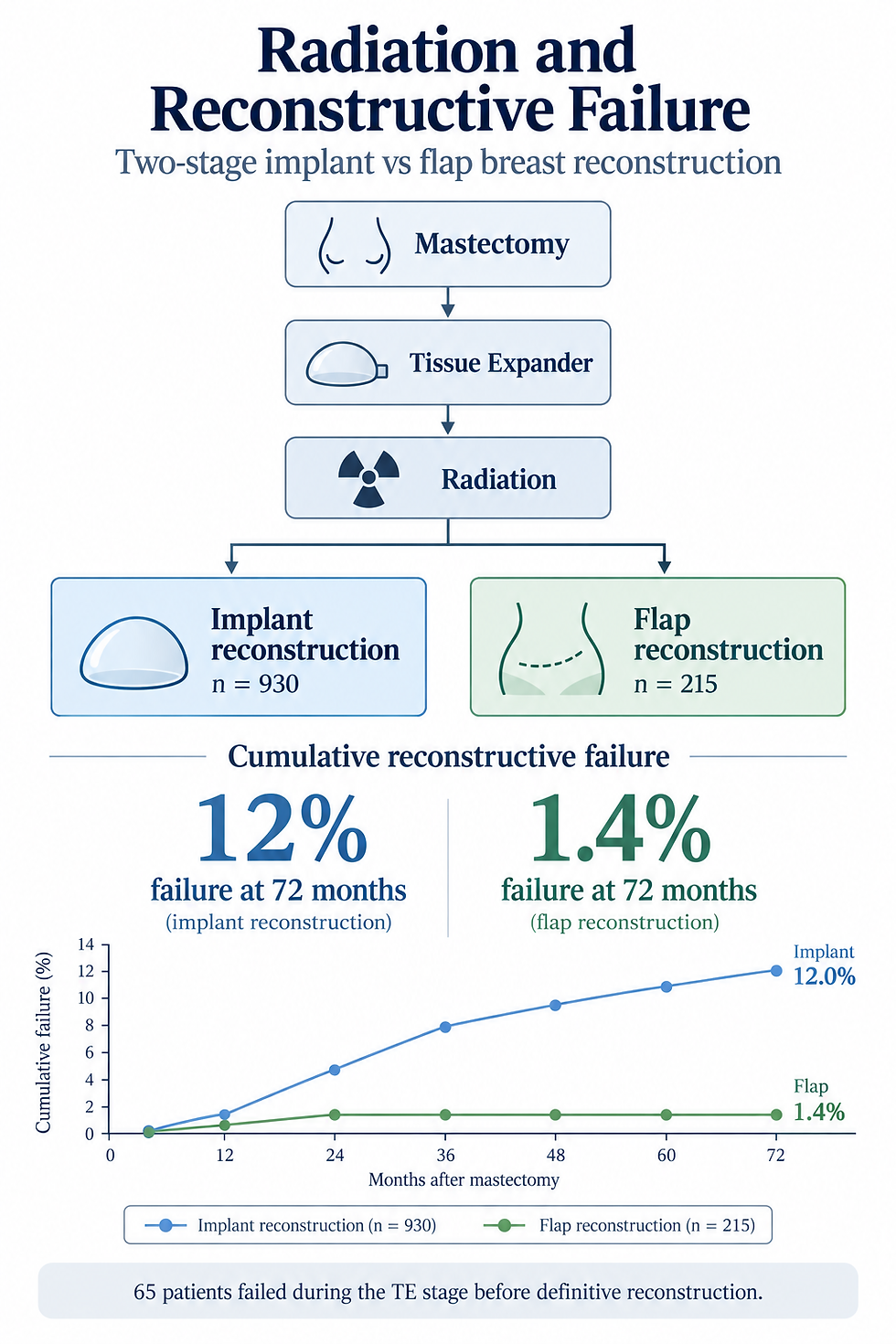
Postmastectomy radiation is a major clinical risk factor for CC in reconstruction cohorts.
Additional factors discussed include incision choice and implant characteristics; literature is mixed and confounded by era effects and patient selection.
Diagnosis and grading

Baker I–IV grading remains the clinical standard though subjective; ultrasound and MRI criteria are being explored as adjuncts but lack consensus replacement value.
Prevention strategies
Reduce microbial burden: Chlorhexidine skin prep; pocket irrigation with antiseptics/antibiotics; adherence to no‑touch technique and use of nipple shields to limit contamination.
Implant/material choices: Thoughtful selection of implant characteristics; adjunct use of acellular dermal matrix (ADM) or synthetic mesh may support thinner, more compliant capsules. Comparative data are heterogeneous; recent series show low CC rates with both biologic and synthetic meshes.
Pharmacologic adjuncts: Off‑label leukotriene receptor antagonists and short steroid/NSAID regimens are reported; efficacy signals are variable across small, nonrandomized studies. Monitor for drug‑specific risks (e.g., hepatotoxicity with some leukotriene agents).
Treatment algorithms
Early or mild CC (Baker II–III): Trial of medical therapy (e.g., leukotriene inhibitors) and close observation; proceed to surgical release if symptomatic or deforming.
Surgical management:
Capsulotomy is often favored for thin capsules and less severe disease due to shorter operative time and recovery.
Partial or total capsulectomy is reserved for severe, recurrent, calcified, or adherent capsules; pair with implant exchange and a renewed prevention bundle.
Adjuncts: Consider fat grafting for pain/contour and soft-tissue quality; reapply antisepsis/irrigation and no‑touch principles at revision.
Conclusion
A patient‑specific, multimodal strategy—meticulous technique, contamination control, judicious use of materials, and targeted adjunctive medications—best prevents and treats CC. Stronger prospective studies are needed to define optimal protocols and long‑term outcomes.
Strengths and limitations
Strengths of the review: Comprehensive, pragmatic synthesis spanning epidemiology to revision surgery; offers clinically usable bundles and algorithms.
Limitations of the evidence base: Predominance of observational designs, heterogeneity in implant types/planes/radiation exposure, subjective outcome grading (Baker), and inconsistent reporting; no RCTs.
Clinical relevance
Ensure standard preventative measures are in place for all implant cases: modern skin antisepsis, pocket irrigation, no‑touch/nipple shields, nicotine cessation counseling, and deliberate implant/plane/material choices—especially in radiated fields.
For early Baker II–III, a brief trial of medical therapy with documented monitoring can be reasonable; escalate promptly to capsulotomy if symptoms or deformity persist.
For severe or recurrent CC, plan partial/total capsulectomy with implant exchange, reinforce prevention measures, and set expectations about recurrence risk and the role of explantation.
Editorial Notes
Evidence quality and consistency: The reliance on retrospective series and subjective grading limits causal inference and protocol standardization. The Baker's classification is a poor and subjective outcome measure. To truly tackle this problem, plastic surgeons desperately need an objective and reliable way to measure capsule biomechanics.
Biofilm vs inflammation: The review appropriately treats biofilm as contributory within a broader inflammatory cascade; however, we lack prospective data isolating the incremental benefit of each prevention‑bundle element. Future work should test bundle components in factorial or pragmatic designs.
Mesh and materials: Observational series suggest low CC rates with both biologic and synthetic meshes, however, the data is far from robust and should be interpreted with caution. Note that most included studies were conducted in aesthetic augmentation populations rather than reconstructive cohorts.
Management decisions: Capsulotomy may suffice for thin capsules, but understand that this does not usually address the (presumed) inciting cause.


Comments